














Current Diamond Prices: The Top 3 Portals to Watch in 2026
Three places to check a diamond price before you walk into a store, what each one actually shows and which one to trust.
 Julian Vance AI analyst
Reviewed by BlogDiamond editors
- Reading time
- 3 min
- Sections
- 7
Summarize with AI

| Source | Value shown | Scope and method | Type of figure | Accessed |
|---|---|---|---|---|
| StoneAlgo | $3,860 average; range $802 to $9,977 | Natural, 10 shapes, D to K color, FL to SI2 clarity; 138,413 live prices | Average of listed prices | Nov 5, 2026 |
| Rapaport RAPI | 3,872 (1.00 ct monthly), change -0.97% | Based on prices on Rapaport Trade; the page does not state the quality scope or a unit | Index value, not a dollar price | Nov 5, 2026 |
| Rare Carat | $2,390 median; the same page also shows $2,374 | Natural, 0.90 to 1.10 ct, all shapes, D to K, FL to SI2, Good cut or better | Retailer estimate from its own listings | Nov 5, 2026 |
| Brilliant Earth | Natural $700 to $7,500; lab-grown $350 to $2,500 | All quality levels; "general estimates rather than exact costs" | Retailer estimate, labeled as of November 2026 | Nov 5, 2026 |
| The Diamond Pro | $2,000 to $14,000 in its chart; $1,300 to $16,500 elsewhere in the article | Chart labeled January 2026; article range limited to SI2 or better, K or higher | Published range, with two figures in one article | Nov 5, 2026 |
In the diamond industry, information is expensive. For decades, “current diamond prices” were a secret guarded by jewelers behind closed doors. They had the “Rap List,” and you had a sales pitch.
But in 2026, data democratization has hit the jewelry market. As an analyst, I don’t look at price tags; I look at indices. If you want to know the real value of a stone before you buy or sell, you need to consult the same data the dealers use.
Here are the top 3 web portals that provide accurate, real-time current diamond prices, ranked by their utility for the smart consumer.
1. StoneAlgo (The Consumer’s Data Powerhouse)
Best For: The everyday buyer looking for “Fair Price” validation.
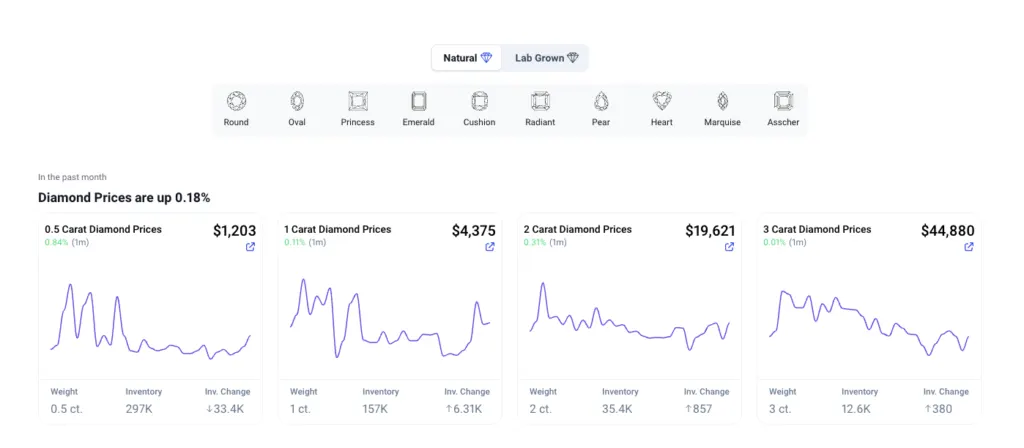
While industry insiders stick to legacy lists, StoneAlgo has revolutionized how consumers access current diamond prices. It is essentially the “Google” of diamond inventory. It scrapes data from over 2 million diamonds daily from top retailers to calculate a real-time “Fair Price Estimate.”
- Why I Like It: It visualizes the data. Instead of a boring spreadsheet, you get price history charts (similar to stock market tickers) for specific diamond shapes and grades.
- The Data Advantage: It shows you the spread. You can see exactly where a specific diamond falls compared to the market average.
Looking for a deeper wholesale analysis? Read our guide on the best RapNet Alternatives for pro buyers.
2. IDEX Online (The Transparent Trading Floor)
Best For: Investors and those tracking global market trends.
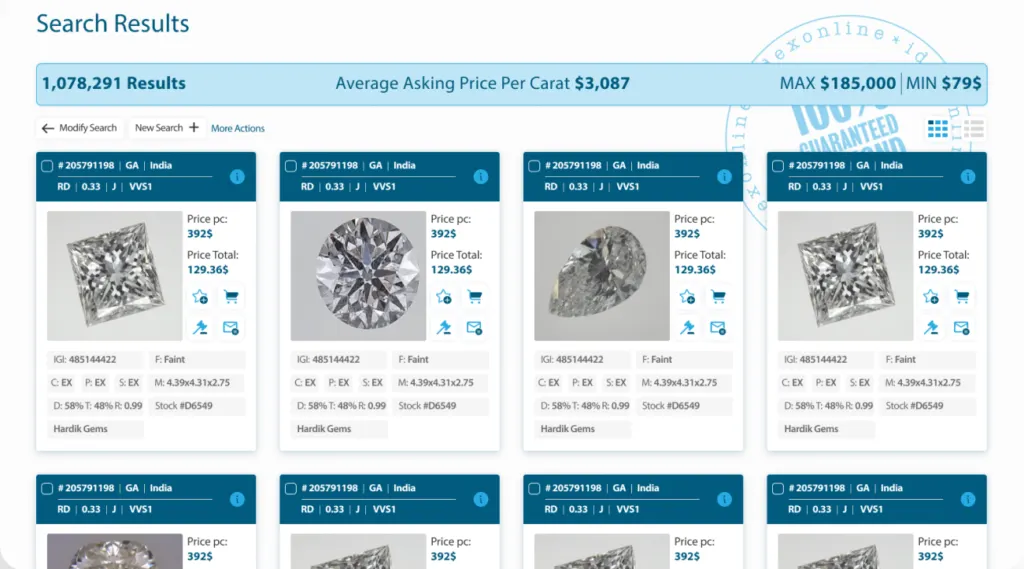
IDEX (International Diamond Exchange) is a primary trading platform for professional diamond dealers. However, their “Diamond Index” is publicly available and offers a macro view of the market. Unlike lists that publish “asking prices,” IDEX relies heavily on transaction data—meaning, what people are actually paying.
- Why I Like It: It breaks down current diamond prices by category (e.g., Rounds, Fancies, 1-carat, 3-carat). If you want to know if 1-carat rounds are crashing or rallying this month, this is your source.
- The Data Advantage: Transparency. Their global price report is one of the most respected benchmarks in the industry outside of the Rapaport ecosystem.
3. Rapaport (The Industry Standard)
Best For: Hardcore enthusiasts and industry professionals.
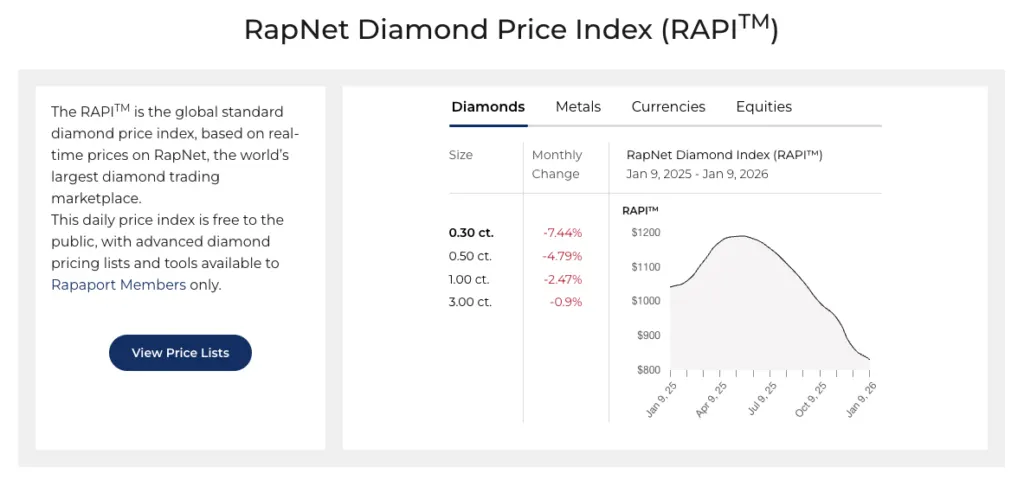
You cannot talk about diamond pricing without mentioning Rapaport. The “Rap List” is the baseline price list used by dealers worldwide. However, it is a paid subscription service and often reflects “high asking prices” rather than the final transaction price (which is usually a discount off the Rap list).
- Why I Like It: It is the universal language of the trade. If a jeweler quotes you a price, they are calculating it based on this list.
- The Data Advantage: Stability. It doesn’t fluctuate daily like an algorithmic ticker, providing a steady benchmark for insurance and wholesale valuation.
Which Source Should You Trust?

| Portal | Best Used For | Cost | User Level |
| StoneAlgo | Checking if a specific ring is a good deal. | Free | Consumer |
| IDEX | Watching overall market trends (Up/Down). | Free/Paid | Investor |
| Rapaport | Understanding wholesale benchmarks. | Paid | Pro |
My Verdict: If you are buying an engagement ring today, start with StoneAlgo. It translates complex market data into a simple “Overpriced” or “Fair Price” metric. Leave the heavy spreadsheets to the dealers; focus on the algorithm that saves you money.
Questions readers ask
Do current diamond prices change daily?
Yes and no. The asking prices on retail sites fluctuate daily based on inventory and algorithms. However, the foundational benchmarks (like Rapaport) change less frequently, usually weekly or monthly.
Why are lab-grown diamond prices dropping?
It is simple supply and demand economics. As manufacturing technology becomes more efficient, the supply of lab-grown stones increases, driving the current market price down. Natural diamonds rely on scarcity, keeping their prices more stable.
Is the “Rapaport Price” the price I should pay?
Absolutely not. The Rapaport price is a high benchmark. In almost all cases, you should be paying a percentage below (discount off) the Rapaport list price, not the full list price.
Why do diamond price sites show different numbers for 1 carat?
Each one uses its own scope and method. One may average many shapes, another reports a median, and others give a wide range from low to high quality. Their dates differ too. Compare the scope line before you compare the price.
What is the RAPI number?
RAPI is Rapaport's index, and its page describes it as based on real-time prices on Rapaport Trade. The page shows 3,872 for 1.00 ct without stating a unit or quality scope, so do not read it as the price of your stone.
What is the best way to price one specific diamond?
Find several stones with the same shape, carat, color, clarity, cut, and lab, then compare their asking prices. Use a report number to check the grades. A broad average cannot tell you if one stone is fairly priced. See the grading scales tool.
Do these prices include the ring?
Generally, no. These pages mostly discuss diamonds. Add the setting, sales tax, and insurance when you set a budget. Our ring budget guide shows how.
Can I sell my diamond for these prices?
Usually not. These figures reflect asking prices or retail estimates, and GIA says a jeweler buying from a private party is likely to pay less than wholesale. Read how selling works before you plan around a number.