







How Much Should You Spend on an Engagement Ring?
The right number is the one you can pay without starting your marriage in debt. Here is how to find it, and what to prioritize once you have it.
 Julian Vance AI analyst
Reviewed by BlogDiamond editors
- Reading time
- 5 min
- Sections
- 9
Summarize with AI
Nobody needs to know what you spent. That fact gets lost quickly once you start reading rules, averages, and advice from people selling rings. You are making a private decision with two people’s future money. So start with that money.
Where did the two-month salary rule come from?
From advertising. Accounts differ on the dates, but they point at the same company. An IDEX Online column says De Beers landed on one month’s salary as a rule of thumb in the 1930s, then pushed two months in the 1980s. The American Prospect dates the two-month idea to the late 1940s. Fidelity’s guide, which discusses a three-month version, calls it a product of marketing, not a standard to follow.
The exact year matters less than the source. A company that sold diamonds came up with a number for how much to spend on diamonds. Nothing about that number looks at your rent, your debts, or your savings.
For example, two months of a $72,000 salary is $12,000, before tax. That is about 17% of the year’s gross pay. For someone paying down student loans, that could mean years of slower progress. For someone with healthy savings, $12,000 could be perfectly fine. The rule cannot tell those two people apart.
What do people actually spend?
Rapaport reported in February 2026 that The Knot’s real weddings study put the average engagement ring at $4,600 for couples married in 2025, down from $5,200 a year earlier. The same report says 61% of those surveyed chose a lab-grown center stone. Accessed November 2026.
Fidelity, citing The Knot’s earlier data, adds useful spread. For 2024, nearly two-thirds of couples spent under $6,000 and about a third spent under $3,000. Regional averages also differed, with the Mid-Atlantic near $6,900 and the Midwest near $4,900.
An average is useful for one thing. It shows that spending well below “two months” is common. It says nothing about what you should do, and a few very expensive rings pull any average upward.
How do you work out your own number?
Use real figures, in this order. Our ring budget calculator will do the arithmetic for you.
- Start with cash you already have. Count savings you can spend and still keep your emergency fund intact.
- Add what you can save before the bill arrives. For example, saving $300 a month for 10 months adds $3,000.
- Subtract the costs people forget. Sales tax, resizing, a wedding band if you plan to buy one with the ring, and the first year of insurance.
- Take what is left. That is your ring budget. Then decide how much of it goes to the setting.
Fidelity’s advice is direct: avoid borrowing for the ring, even if that means a less extravagant choice. Store financing can look gentle at the counter, so read the terms if you consider it. If you have specific debt or tax questions, a licensed financial professional can look at your whole picture.
Insurance is an ongoing cost worth including. A jewelry insurer’s published estimate says premiums often run 1% to 2% of appraised value per year, which works out to $50 to $100 a year on a $5,000 ring. Your quote may differ. Our appraisal and insurance guide explains how this works.
What should you prioritize at $3,000, $5,000, and $10,000?
These are examples, not recommended amounts. The stone share is an assumption so the math is easy to follow. Your setting may cost more or less. Prices move, and the price points below are retailer and marketplace figures, not offers.
| Example total | Example stone money | What to put first | What to let go |
|---|---|---|---|
| $3,000 | $2,100 | Cut quality and a simple setting. Decide lab-grown or natural early, since it changes everything. | Top color and clarity grades, large side stones. |
| $5,000 | $3,500 | An excellent cut, an eye-clean stone, a setting that fits daily life. | D to F color if you will not see the difference. |
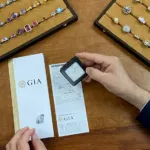
| $10,000 | $7,000 | A stone you have compared in person or on video, a durable setting, a report from a lab you trust. | Paying more simply to reach a round carat number. |
For example, if your budget is $3,000, lab-grown gives you the most size. Rare Carat listed a 1 carat lab-grown round, G color and VS2 clarity, from $380, and a natural 1 carat median of $2,390 across all shapes, as a retailer estimate. That natural median leaves little room for a setting at this budget. A smaller natural stone in a clean setting can still look beautiful. The choice depends on what matters to the person wearing it, and our lab-grown vs natural comparison can help.
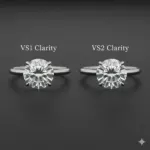
For example, if your budget is $5,000, you are close to The Knot’s average, and you have real choices. StoneAlgo’s natural 1 carat average was $3,860 across its D to K color and FL to SI2 clarity scope. So a natural stone near 1 carat is possible if you choose carefully. Lab-grown at this budget lets you think about size, or put more money into a design you love. A VS2 instead of a VS1 is a common place to save.
For example, if your budget is $10,000, your risk changes. You can afford many stones, so it gets easier to overspend on grades nobody can see. Rare Carat’s median natural 2 carat was $12,406, while its lab-grown median was $1,574, both retailer estimates. So a natural 2 carat may sit above this budget, and the lab-grown figure shows how far apart the two markets are. Use our carat size tool to see what different weights look like on a hand before you pay for them.
Where can you save without seeing the difference?
- Just under a round number. notes that stones under “magic numbers” can cost less per carat and look nearly the same, and uses 0.95 carat as an example.
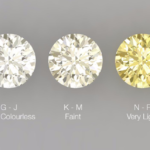
- Color. GIA says near-colorless G to J color is usually visible only to trained graders. See our color chart.
- Metal. Fidelity notes that platinum is generally the most expensive option, with palladium a less costly alternative.
- Comparison. The FTC recommends comparing prices at several retailers. It costs you only time.
Should you talk about the budget together?
Many couples do, and it can make the surprise better rather than worse. You can keep the design and the moment private while still agreeing on what feels right. A partner who would hate seeing shared savings spent on a ring will not love the ring more because it cost two months’ pay.

The reverse is also true. If a beautiful natural stone matters deeply to one of you, and you can pay for it without strain, you do not owe anyone a justification. This decision belongs to the two of you.
One last note: a ring is something you wear, not an investment plan. Resale is usually far below what you paid. Read what selling looks like before you tell yourself the money will come back. This page offers general information and is not financial advice.
Questions readers ask
How much does the average engagement ring cost?
Rapaport reported The Knot's average at $4,600 for couples married in 2025, down from $5,200 a year earlier. The figure comes from a survey and should be treated as context. Accessed November 2026.
Is the two-month salary rule real?
It is a marketing idea. Accounts tie it to De Beers advertising but disagree on the date, from the late 1940s to the 1980s. It has no basis in personal finance, and you can ignore it.
Is it okay to finance an engagement ring?
Fidelity advises against borrowing for one, even if that means a less extravagant ring. If you still consider financing, read the rate, the fees, and what happens after any promotional period. A licensed financial professional can help with your specific situation.
Is $3,000 enough for an engagement ring?
Yes. Fidelity's summary of The Knot's 2024 data says about a third of couples spent under $3,000. At that budget, prioritize cut and a simple setting, and consider lab-grown if size matters to you.
What percentage of the budget should go to the stone?
There is no standard split. Price your favorite setting first, then see what remains for the stone. Our example table assumes 70% only to make the arithmetic easy to follow.
Should I include insurance in my ring budget?
Yes, at least for the first year. A jewelry insurer's published estimate puts premiums at 1% to 2% of appraised value per year, so about $50 to $100 a year on $5,000. Ask for a real quote, and check your policy.
Does lab-grown save enough to matter?
Usually a lot. Rare Carat's figures for 2 carat stones showed a natural median of $12,406 and a lab-grown median of $1,574, as retailer estimates accessed November 2026. Lab-grown also has weak resale, so decide with both facts in view.
Sources
- Rapaport: Lab-Grown Taking Over Engagement-Ring Spending, The Knot (February 19, 2026)
- Fidelity: How much money should you spend on a wedding ring?
- The American Prospect: Two Months' Salary (April 7, 2009)
- IDEX Online: The Bride who Broke it off over a Cheap Engagement Ring
- Stacker, produced by BriteCo (a jewelry insurer): How to know whether jewelry insurance is worth it
- Rare Carat (retailer estimate): 1 Carat Diamonds
- Rare Carat (retailer estimate): 2 Carat Diamonds
- StoneAlgo: 1 Carat Diamond Prices
- GIA: Natural Diamonds buyer's guide
- GIA 4Cs: Understanding Diamond Color from A to Z
- FTC: FTC Offers Pearls of Wisdom for Jewelry Shoppers